Monday, October 30, 2006

The case for a British astronaut

Aaaaand we're back. What no-one teaches you at blogging school is that it's tough work maintaining an interesting blog and working for a living. Fortunately, I've managed to combine the two in this latest post.

The more I think about the decline in science at schools and university, the more I wonder why all attempts to deal with it are so conservative. To some people, the solution is very simple: the apathy is caused by bad teachers. Pay them more and watch the students flock back. But that's like saying that we know carbon dioxide causes global warming so why don't we all just stop producing it? No doubt it's a problem and it needs addressing but why don't we get a bit more creative? After all, there's more than one way to crack a nut. Here's an idea I'd like to to throw into the mix, published in today's Guardian.

It's a quandary: Britain's supply of scientists and engineers is dwindling. Hi-tech companies are bemoaning the shortage of good graduates, the Treasury is getting twitchy about the economic implications, and government education advisers are left scratching their heads.

If only there were something inspirational that could turn children on to physics or engineering. Something that could demonstrate the excitement, adventure and sense of discovery that is at the core of science.

Here's a radical idea: send a Briton into space. Not on some half-hearted tourist trip to watch the Earth for a few days from the International Space Station, but a research-based programme with a specific mandate to inspire budding scientists. The dividend is clear. A generation of children jumped into science thanks to the American moon landings in the 1960s. In the US, the number of PhDs awarded in technical fields rose steadily during the Mercury and Apollo programmes from 1961 to 1972.

Britain's less-than-progressive attitude to sending people into space was neatly summed up by the science minister Lord Sainsbury in a 2003 speech. "There is no doubt that manned space exploration has a special excitement for people, and a particular attraction for young people," he said. "It does not, however, make a great deal of sense either commercially or in terms of doing world-class science."

In claiming there is no world-class science to be done with humans in space, he ignores the fact that almost all of the world's major economies think enough of the scientific return to invest heavily. Europe and the US have announced bold human space programmes spanning the next few decades; Russia, China, India and Japan plan to follow suit.

And commercial opportunities? Perhaps Richard Branson could have saved himself the trip across the Atlantic to buy his hardware for Virgin Galactic if Britain's space industry had come up with the goods.

Britain's decades-long rejection of the idea of human space flight was supported by a major review commissioned by the Science and Engineering Research Council in 1989. In looking at how research could benefit from sending people into space, it concluded that, because microgravity research was in its infancy, there was little point in spending the money. It cemented the view in government circles that sending people into space cost too much and had no scientific benefit.

Times change, and science marches on. A year ago, the Royal Astronomical Society (RAS) published a report that confounded the sceptics. Its nine-month investigation into the scientific case for human space flight concluded that the profound scientific questions relating to the history of the solar system and the existence of life beyond Earth could best, and perhaps only, be achieved by human exploration on the moon or Mars. It was all the more remarkable because the scientists leading the investigation started off being sceptical about the value of human space flight.

The report finished with a passionate plea: "It is hard to conceive that the UK, one of the world's leading economies, would stand aside from such a global scientific and technological endeavour. We therefore regard it as timely for Her Majesty's government to re-evaluate its long-standing opposition to British involvement in human space exploration."

A year on, Her Majesty's government has paid no attention to this golden opportunity to revitalise British science. Its head remains buried the sand.

Cost is obviously the sticking point. Getting into space is expensive, sending humans there doubly so. The RAS report suggested full membership of the European Space Agency's (Esa) Aurora programme, an ambitious initiative to send humans to Mars by 2030. For Britain, Aurora comes with a price tag of £150m a year for at least the next two decades, and membership doesn't guarantee a British astronaut. It's not a proposal that is likely to fly with the Treasury.

The answer lies in a more limited plan. A couple of flights with a set of experiments and an extensive programme of education would be enough to give Britain's emerging human space flight science community a chance to prove its value. Schools could be involved and science undergraduates could take part in competitions to design experiments. It's already done across Europe.

Initial calculations suggest such a programme could cost as little as £50m over 10 years. By investing less than a tenth of the amount spent on the Millennium Dome, Britain could cut its teeth on the next stage of human exploration and get a return - scientific, industrial, educational and cultural - worth several times the money put in.

There is little time left to decide: Esa and Nasa will both finalise their plans for the moon and Mars in the next few years. If we want to get involved, we need urgent action. By continuing to opt out, Britain will lose its best chance to show children how exciting science can be. We will also lose to the more ambitious nations those scientists who see space as the future. In the next decade, the question may no longer be whether we can afford to send people into space, but rather, can we afford not to?


The people leading this resurgence of interest in human space flight include Kevin Fong at University College London and Ian Crawford at Birkbeck College. They've put together a summary of the scientific case for a British astronaut here. What this needs is a consistent campaign or a more regularly-maintained web site or blog to keep people up to date and to suggest ways to lobby government. Any ideas welcome.

Read More...

Thursday, September 21, 2006

Atlantis and ISS drift across the Sun


What a stunning picture. It shows space shuttle Atlantis (left) just after it detached from the International Space Station (ISS) on September 17. Taken from the ground in Normandy by astrophotograher Thierry Legault. Distance between Atlantis and the ISS is 200m and that white background is the Sun. The two spacecraft drifted across our star for barely a second, so this photograph is a technical masterpiece. As well as being, well, just awe-inspiring.

The full-sized picture is here, showing Atlantis and the ISS against the full backdrop of the Sun.

Read More...

Design this, suckers

Stories like this are great. Published in Nature today, details of new fossil remains found in Ethiopia - 3.3 million year old bones that belonged to a child of the species Australopithecus afarensis, the same as Lucy, the famous adult female discovered in 1974 and believed to be a direct relative of the human genus, Homo. It has been nicknamed Selam, meaning "peace" in the local language and is a critical fossil in showing how humans first branched off the larger ape family.

There's a wonderful sense of discovery in knowing where and how humans evolved. But a discovery like this also serves another, more viscerally satisfying, purpose: it's another in the beautiful catalogue of pokes in the eye for intelligent design.

Read More...

Exposing the lies of the climate change deniers

The Royal Society (the UK’s academy of science) has written to the oil company ExxonMobil to insist it stop funding climate change deniers. These groups (nothing more than PR fronts for the oil industry) have created so much doubt and confusion about limate change that the environmentalist George Monbiot argues they have set back action on the issue by a decade. And, all the while, the world desperately runs out of time.

A key passage from the Royal Society letter to ExxonMobil reads:

I was very surprised to read the following passage from the section on Environmental performance under the sub-heading of “Uncertainty and Risk” (p.23) in the “Corporate Citizenship Report”.

“While assessments such as those of the IPCC have expressed growing confidence that recent warming can be attributed to increases in greenhouse gases, these conclusions rely on expert judgement rather than objective, reproducible, statistical methods. Taken together, gaps in the scientific basis for theoretical climate models and the interplay of significant natural variability make it very difficult to determine objectively the extent to which recent climate changes might be the result of human action”

These statements also appear, of course, in the ExxonMobil document on “Tomorrow’s Energy” which was published in February. As I mentioned in our meeting in July, these statements are very misleading. The “expert judgement” of the Intergovernmental Panel on Climate Change was actually based on objective and quantitative analyses and methods, including advance statistical appraisals, which carefully accounted for the interplay of natural variability, and which have been independently reproduced.
And there you have a good example of how these PR firms create confusion. On reading ExxonMobil’s report, anyone could be forgiven for thinking that the IPCC were a bunch of astrologers plucking ideas on climate change out of the air. If you had never heard of the IPCC before, would you believe that they their judgements were scientific and proper?

Do just a moment of Googling and it's easy to discover that the IPCC is an august group that sets the scientific standard in climate research. But how many people will bother to look that up? And, of those that don't, how many will be left confused?

Is there really a debate amongst scientists about the reality of human-influenced climate change? The answer is no. But the damage done by ExxonMobil (among others) done by creating the doubt in the first place is tough to repair.

Big oil has a lot to lose with any cutbacks on carbon emissions imposed by legislation to deal with climate change. So it’s no surprise that they have a vested interest in sewing doubt about whether climate change is really a problem. They do it by labelling any research that doesn’t support their proposition “junk science” and labelling anything that doubts climate change “sound science”.

The anti-climate change lobby groups (mostly US-based) have a range of impressive-sounding names meant to instil the idea that they are academic think tanks or grassroots citizens’ organisations: TechCentralStation, the Cato Institute, the Heritage Foundation, the Centre for the Study of Carbon Dioxide and Global Change and the Congress of Racial Equality, for example.

Why scientists haven’t got more riled about this, and earlier, is anybody’s guess. Much of Monbiot’s thesis is well-known, if not in well publicised. Relying on the slow and steady scientific method to convince the rest of the world that climate change is happening isn’t a good idea - perhaps scientists (and journalists) need to use the same campaigning tactics used by big oil, as described by Monbiot in an extract from his new book in the Guardian. The Royal Society should be applauded for using its clout (there are many climate scientists in its ranks) to point out the hypocrisy and lies touted by climate change deniers.

Most surprising (and sinister) is the description of how the climate change denial industry sprung from Big Tobacco’s desperate attempts to discredit research suggesting that smoking caused lung cancer.

Read Monbiot’s new book (called Heat and published by Allen Lane) and open your eyes to the distortion that is possible with a sinister PR machine that will vociferously argue for anything as long as the price is right.

Read More...

Monday, September 18, 2006

Guardian science podcast for September 18, 2006

The latest podcast from the Guardian’s science team is up today. This week’s show, presented by science correspondent James Randerson, features a report on the Neanderthals’ last stand (a cave on the rock of Gibraltar), a treasure trove of science papers released by the Royal Society, and an interview with the roboticist Mark Tilden (the man who invented the Robo Sapiens toy).

Fossil hunter Clive Finlayson of the Gibraltar Museum tells Ian Sample how it felt to be sitting in the final resting place of the last known human species other than our own. Stone tools dated as young as 24,000 years ago litter the floor of the cave and there’s a possibility that underwater caves nearby will provide even more information on how these humans lived – and why they died. Until now, it was thought the Neanderthals died out more than 30,000 years ago.

Interested in the history of science? This Royal Society archive is for you. Librarian Keith Moore talks about the Society’s initiative to let people trawl through its vast archive of scientific research, a massive collection of papers dating back to 1665. Amongst the gems are Arthur Eddington’s proof of Einstein’s theory of relativity in 1919; and the first ever descriptions mammoth bones; and the tale of a musical child prodigy – Mozart. Hurry though, the archive is only online free for the next two months.

An interesting theme that runs through the archive is how science emerged as a discipline from a bunch of well-heeled people carrying out crazy experiments. The Philosophical Transactions of the Royal Society, where much of its fellows’ work was published in the early years shows how people wanted to design repeatable experiments so that others could test their ideas. It’s a powerful testament to the strength of science that this method has survived for so long and, let’s not forget, has brought us some incedible advances in knowledge.

The types of experiment that people have tried over the years is interesting too – Charles II mocked members of the Royal Society when they wanted to weigh air, obviously thinking that there was nothing there. A hundred years ago, the American physician Duncan MacDougall tried to weigh the soul in the name of science – he got a figure of 21 grams. We all know which one of those proved the more useful activity, though MacDougall’s work did make it to Hollywood as the title of a 2003 movie starring Sean Penn and Naomi Watts.

And finally, if you grew up in the 1960s, you probably thought we’d be living in the Jetsons by now – flying cars, honeymoons in orbit and robots in the home were all just around the corner. Unfortunately, robotics has been a big disappointment in the years since. Computers have become phenomenally fast, efficient and useful but modern robots can’t do much beyond simple tasks such as spray-paint cars or repeat simple recorded phrases on cue.

Former Nasa scientist Mark Tilden, the rock star of robotics, talks to technology correspondent Bobbie Johnson about his dream to make robots in the home a reality. He reckons that robots are at the stage now where cars and airplanes were 100 years ago. But he is convinced that things will move fast – in the next two years, they will be doing things that will be useful to people beyond just entertainment.

You can download the show or subscribe via iTunes. There is also an archive of previous science podcasts covering everything from the best science books to high-altitude telescopes.

Read More...

Thursday, September 14, 2006

Science doesn't need gatekeepers

Ever thought there was a media conspiracy going on, something meant to twist information beyond all recognition? You're probably not alone. Does it happen in science reporting? For the most part, any blind twisting of data or research is the domain of a few mad columnists. News reporting tends to fair and accurate. But things can go tits up sometimes.

Here's an interesting example from the British Association festival of science, which ran last week in Norwich, normally a treadmill of stories ranging from anthropology to nanotechnology. But one tale grabbed more attention than most - a controversial Cambridge University biologist called Rupert Sheldrake who said that he had uncovered evidence for telephone telepathy. If you haven't come across Sheldrake before, just know that he has some very strange ideas about psychic pets and whether animals will wake up if you stare at them.

Telephone telepathy is the phenomenon whereby you supposedly know who is calling before you pick up the phone. Normally banished to the realm of nonsense pseudoscience, it's mostly a harmless pursuit. But Sheldrake had done some experiments and came to Norwich to tell the world. This got some of the press pack in Norwich very upset.

Ted Nield, chair of the UK Association of British Science Writers, writes a colourful account of the day when science journalism began to eat itself on the ABSW blog.

Peace reigned at the University of East Anglia. Bunny rabbits hopped in newly mown grass. The lake, undisturbed in the September sunshine, reflected the angles of Sir Denys Lasdun’s famous ziggurats. Meanwhile, deep in the concrete jungle behind them, the British Association Annual Festival of Science was feverishly connecting, engaging and outreaching. From the Broad’s tranquil shore, you would never have known.

But the British public had only 12 hours to wait before quite a different picture would emerge in the pages of The Times, The Daily Telegraph, and The Independent, from which you would think that the shining lake had been a seething morass of angst and bile. Despite all evidence to the contrary, the whole edifice of science was apparently being assaulted and insulted - at the hands of an organisation founded to promote it. Scientists’ screams and moans were drowned only by the occasional sound of breaking glass, as various defenders of scientific rectitude – Lord Winston, Prof. Richard Wiseman, Sir Walter Bodmer, Prof. Peter Atkins and “A Royal Society spokesman” – apparently ripped their heads off in protest and threw them out of the windows. “Uproar at top science forum” thundered the Thunderer. “Festival attacked” screamed the Telegraph. “Scientists angry” asserted the Independent.

Interestingly not one of those allegedly indignant luminaries was anywhere near Norwich at the time.
Read the full article here

I was in the press room in Norwich while the saga unfurled and I was also at the press conference where Sheldrake presented his research.

The sentiment guiding the journalists behind the ensuing witch-hunt was impeccable. Telephone telepathy is a nonsensensical idea that doesn't fit any part of the scientific canon. The best reaction would have been to ignore it, as journalists do every day with flimsy stories. But, by overblowing it (the Times, Telegraph and Independent did several pages of telepathy-knocking between them) into a supposed row over whether the BA should host an event to showcase such research, the only thing they achieved was to give lots of coverage to an issue that didn't warrant it. Even I wrote a very short story.

The explanations proposed by the Sheldrake for telephone telepathy (including quantum entanglement and morphic fields) won't hold up. But it's not because the media points out that he is talking rubbish.

Instead, it will be the scientific method - rigorous experiment, peer review, publishing a paper - that will be his downfall. His pilot study of a few dozen people might have given interesting results (and, statistically, they are interesting, no journalist in that press conference could dismiss that) but bigger studies will no doubt prove him wrong. The work will wither away by itself. If Sheldrake's work holds up in bigger studies then things will certainly get interesting, but I'm not holding my breath.

Science doesn't need human gatekeepers to guide its progress. If anything, it's the human element that is science's biggest weakness. Whenever things have gone wrong, you can usually trace the mistake back to a person. The ego of the principal researcher, the war between competing institutions, corruption in funding or downright fraud - that's where inaccuracy comes from.

By definition, discovery is about walking into the unknown. Many of our greatest discoveries came from counter-intuitive thinking from great minds. Sheldrake shouldn't be stopped from researching his telepathy ideas or even presenting them at the festival of science (which, by the way, is a public engagement forum, not an actual science conference where scientists present results to each other). Apart from the obvious moral scenarios it is, in fact, a little sinister that anyone should suggest that certain areas of study are out of bounds.

Sheldrake doesn't need the media to dismiss his research. The scientific method will do that all by itself.

Read More...

Ah, the pleasure of big machines

Nothing like a dose of hard physics first thing in the morning. Even if you don't get the point of this post, just wallow in the numbers.

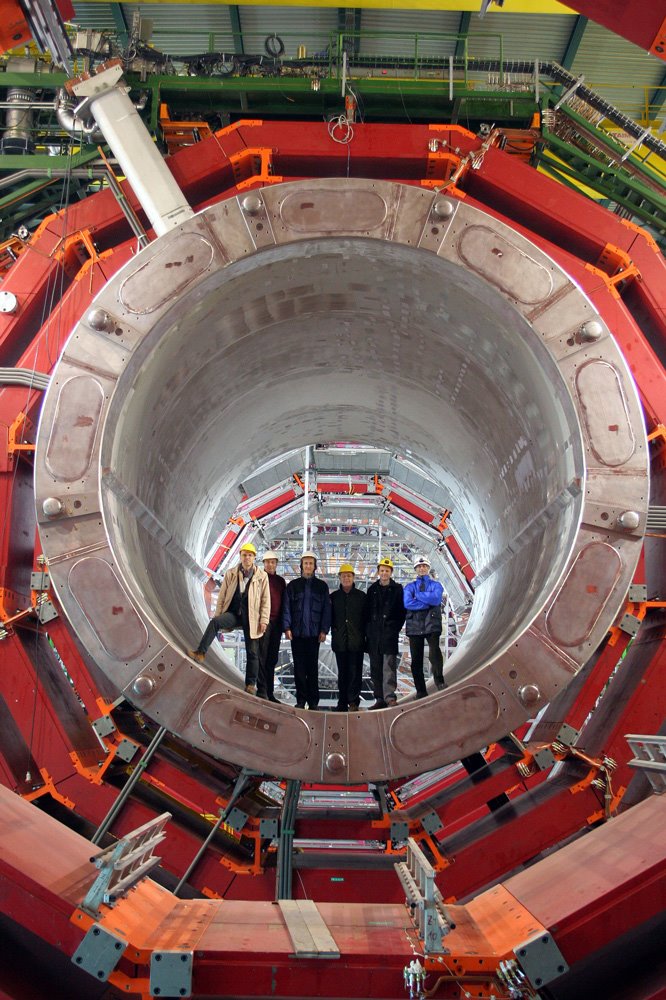
The world’s biggest magnet reached full power yesterday. This 10,000-tonne beast generates a magnetic field more than 100,000 times higher than the Earth’s and stores 2.5 gigajoules of energy. That can melt 18 tonnes of gold, in case that fact is useful to you one day.

The magnet is part of the Compact Muon Solenoid experiment (another example of scientist hilarity as this huge machine is several stories high and more than 13m long – not too compact, really) that will run on the Large Hadron Collider, a particle accelerator being built at Cern laboratory in Geneva. It will help work out where mass comes from and what the “missing” 96% of the universe is actually made from.

The LHC has been underconstruction for several years now and is the most advanced bit of kit that particle physicists will have to work out how the universe came to be as we see it today after the big bang nearly 14 billion years ago.

From the Wikipedia article on the LHC on what physicists will use the collider to find out:
  • Is the popular Higgs mechanism for generating elementary particle masses in the Standard Model violated? If not, how many Higgs bosons are there, and what are their masses?
  • Will the more precise measurements of the masses of baryons continue to be mutually consistent within the Standard Model?
  • Do particles have supersymmetric ("SUSY") partners?
  • Why are there violations of the symmetry between matter and antimatter?
  • Are there extra dimensions, as predicted by various models inspired by string theory, and can we "see" them?
  • What is the nature of the 96% of the universe's mass which is unaccounted for by current astronomical observations?
  • Why is gravity so many orders of magnitude weaker than the other three fundamental forces
The LHC is one of the most exciting projects in physics and, let's not beat about the bush, a marvel of engineering. Here's a film of how the CMS is put together and how it works. Here's an article I wrote on the LHC a while back.

Read More...